

Last week, I was invited to attend one of the most inspiring workshops I've been attending lately - and I felt that if I shared some of the insights of the workshop then a lot of people could take a lot of value and inspiration from it ...
The conference was produced by the Epoch Times organization - as part of a series of workshops they do for their magazine's readership community - and because I heard a lot of good recommendations about their events - I decided to give it a try myself.
Here are the people / facilitators who did the conference:
Ran Levi -
Founder and presenter of the successful Israeli podcast "Making History"
Entrepreneur and pioneer in the field of podcasting in Israel, founder and presenter of the "Making History" podcast, currently the most successful podcast in Israel with over 100,000 listeners and 60 million downloads.
Writer and Electronics and Software Engineer.
He has lectured on science and technology to the general public for 20 years, and writes in various settings: Ynet, Calcalist, Odyasa, Galileo Young and more.
Mila Finkelstein
Entrepreneurial and expert in storytelling, messaging, presentations and body language
Lectures and gives workshops in the world of business, entrepreneurship and academia, accompanied by Israeli and global companies, senior executives, salespeople and politicians in brand storytelling, corporate communication, messaging, speeches and presentations.
Comes from the debate field (Open Israel Champion and 17th in the world).
Nir and Gali
The creators of the viral web videos of "Nir and Gali"
Nir and Gali are Israeli animators and Nir Gerber and Gali Adelbaum. Producers and owners of the comic animation videos Nir and Gali
We create short video series that are integrated into Keshet's satirical TV show "Wonderful Land".
Guy Lerer
Host of the program "The Tube" on Channel 13 - Facebook page with the largest community in Israel 1,100,000 followers
The Facebook page has eight million followers and is considered one of the most popular Facebook pages in Israel.
He served as a reporter for Yedioth Ahronoth and Channel 10.
Collected granite
Chef, restaurateur, judge in the "Chef Games" and host of "Revolution in the Kitchen" on the network
From the owners of the restaurants "Mechanioda", "Hasdana", "Talvia", "Yodla" in Jerusalem, and from the owners of the restaurants "Palomar" and "Barbari" in London, in addition to the restaurant "Blagan" in Paris.
In 2014, his "Palomar" restaurant in London was declared the best restaurant in the city. In the summer of 2016, the "Barbery" restaurant, in which he is a partner, came third out of the hundred best restaurants in London.
This is an example list of what the conference moderators said it would give attendees:
- How to make a story the next viral thing
- How to use the storytelling technique correctly
- How to persuade and influence with proper content refining
- The storyrelling technique as a marketing tool
- How to create a story that everyone will talk about
- How to speak the client language
- How to create a GAME CHANGER business with the right tools
Insights / lecture summaries:
Ran Levi
The part that I think I liked the most, which for me made the lecture the best - is the part where he talked about what can be learned from "Star Wars"
He talked about the empathy they created for us with the character of the evil one/Darth Vader - and how the whole story is based on the fact that they kept the fact that he is Luke Skywalker's father until the very end - which actually helps the entire film to understand this tension and the not knowing how this evil that begins the movie in that he kills one of his soldiers with a wave of his hand - just doesn't kill Luke Skywalker that easily/simply.
In general, what Sharan was talking about is that even though he testified to himself as a "boring" personality - and as the type of engineer who is not necessarily involved in telling interesting stories - he learned the basic tools/laws - which he claimed helped him create very interesting stories and podcasts...

The key rules / tips as Ren wrote:
- A good story must conflict between the hero and the antagonist (both by the way do not have to be human in the literal sense of the phrase), the stronger and more powerful the antagonist, the better the story. Therefore - do not hide difficult questions and contradictory opinions to the idea you wish to convey: give them a prominent place in the front of the stage - and then let the "hero" face them bravely.
- It is impossible to explain complex ideas to those who do not want to understand them. Therefore, plan the story in such a way as to arouse in the reader the "joy of discovery" and the strong desire to know "why?". Curiosity is among the most powerful human drives.
- A successful explanation rests on prior knowledge that already exists in the reader. One good analogy will save you dozens of pages of texts, equations, images and videos. Your reader has an imagination - turn on the "theatre of the mind"!
Here are the key rules that you have defined:
- The customer is always right! - Learn to see the story from the client's side…
- What is the main idea - It is important first to understand and learn the main idea - THE THEME - before moving on with building the whole story ..
- Build a sturdy, sturdy skeleton - The story must be based on a solid and strong skeleton that will include all the good elements of the story - and most of all - the beginning and end
- A good story needs a great enemy (Do not hide contradictory ideas) - If there is something that contradicts a particular idea - if you are not ashamed to talk about it you will get greater appreciation from the reader
- The audience should want to understand - Have to think what will really make the customer curious and want to understand what's going on in the story
- The analogy is your best friend - If you can say something complex is like something else - sometimes it explains it most easily ...
Mila Finkelstein
Mila talked mostly about how she helps businesses and organizations tell their story in a way that really fits the target audience and creates the biggest impact on customers.
One of the beautiful things she showed was how a camping company instead of making advertisements about their camping equipment - actually creating advertisements to simply inspire their customers - for example, taking their time to go out in the wild and enjoy time in nature - which is actually a side effect that customers don't Just appreciate the company and its values - but also remember it better when they come to gear up for their next trip….

In another video, Mila introduced how to market themselves as a company - so they took ideas that were important to their community and started promoting them -
And so, for example, came the wonderful idea of Paul's shoe movie - of taking the boots of a deceased man before he could go on the big trip he planned:
Below is a list of steps that Mila has presented for a successful story
- Hero - The most important and important stage - one must understand who the hero of the story is
- need - Always at a certain stage a certain need arises for the hero - she talked a lot about the context of Maslow's scale of needs and that it is important to understand, for example, whether it is an existential need - or for example a high need such as respect, etc.
- conflict - At some point, a certain conflict always arises in the protagonist of the story - in many cases the conflict between the emotional and the thinking side
- Enables / Mentors - This is usually the stage where the hero meets some external factor that helps him understand and get a different/additional point of view on the story and thus allows him to reach the most suitable solution on his own
- fulfillment - The final part of every good story - where the need comes to completion and solution - and the hero comes to completion / fulfillment…
I really liked that she talked about the fact that at each stage there are 2 aspects to the story - one at the emotional / emotional level - and one at the rational / intellectual level - which always work together and at the same time.

Nir and Gali
I certainly had the pleasure of getting to know these wonderful pair of creators at this conference - and I just have to say that they were really different from how I painted them in my head - probably also because I thought they were some super professional characters who built their stories after having been expert screenwriters for a long time - and also Because in my eyes their videos are so unique - I thought they would be very extravagant people even though I found out they were actually quite the opposite ...
Then they went on to tell about how they went from independent creation of short videos - to the transition to the creation of videos as part of a great country and the transition to creating a studio that releases a new episode every week... which gave them the right to be much more different to the script and direction and most of the animation work was simply released to external employees
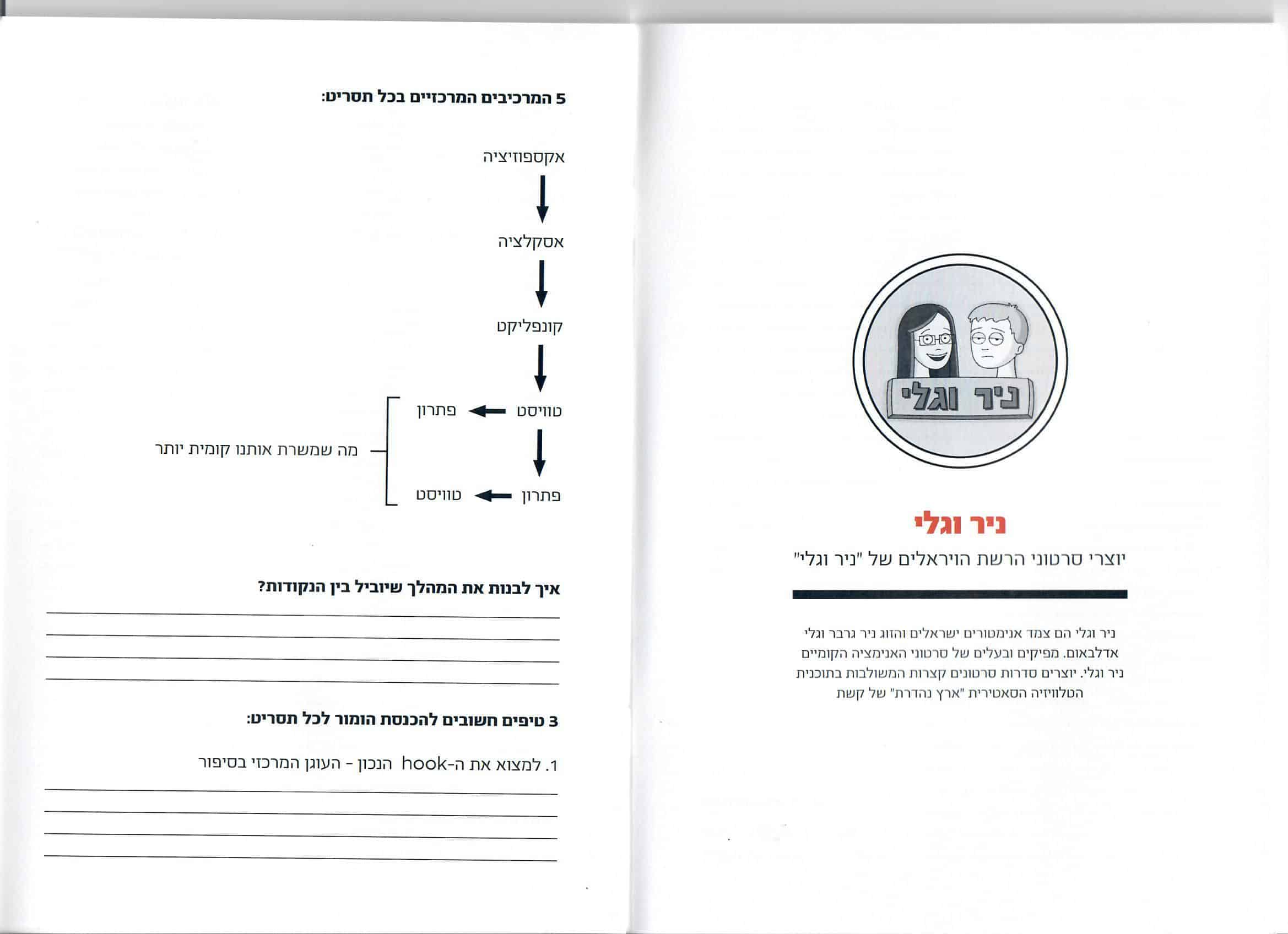
The interesting thing about their lecture is that they showed all the processes they go through in the video creation studio - especially the stage of producing the Storyboard - which is actually a version of the video in static images that help to understand exactly what the story is even before moving on to the animation itself.
The principles of the story they presented:
Exhibition
conflict
Escalation
Twist / resolution
The part that I definitely liked in the lecture was the part they talked about what it was like to take the brief / messages they sent to create an advertisement for Israel Post
- Most secure in the post office bank
- No fees
- There is someone to trust
– And finally, how they made it interesting by understanding the important element in the story and what the story is about, which is actually the bills that so badly want to fly abroad
Guy Lerer
Guy mainly talked about the psychology of virality - and what it actually means and what we can learn from it about the capabilities of modern stories - and how and why we get to share them.
YouTube's Most Viewed Video:
The principles that Guy talked about are viral / sharing:
entertaining
Inspiring
social
Breaking space
Causes doubt
Unusual
exciting
The second most watched video on YouTube:
Why we share videos:
- Self-determination 68%
- Emotion 49%
- What comes out of it is 69%
- Communicate with others 78%

Most viewed videos on the tube page:
Another interesting thing was that Guy said that after testing all the videos on the channel's page, he actually realized that the videos that were shared the most were actually the most social videos - even though they were relatively "boring" they probably still had something that touched the community of the page the most.
The most viewed video on the tube page:
Collected granite
Assaf mainly told of the emotional need for the story to be relevant and to create genuine identification and connection with the customer - and he told how the story of all his restaurants revolves around the wives that the client feels like he really has a real connection not only with the waiter who serves him food - but with the entire restaurant and all The various service people who work there and help the dish reach the customer.
His main story revolved around a new restaurant he opened in London that is located in a designer's building - which doesn't really tell the unique story and create this connection that Assaf wanted so much - so he thought of the idea of asking the designer to prepare several types of mortar and pestle - and thus basically asking the customers to crush the unique mixture of their dish - which also allowed the designer to connect the diners to his designs through the mortar and pestle - also allowed the waiter to connect with the diners by having to explain to them what to do and how to use it - and also allowed a connection to the restaurant and its owner by each time a customer prepared his mixture - He actually made sure to fill the restaurant and the table with the unique aromas of the dish he ordered...
In summary, this is definitely one of the conferences that I liked the most - and I liked the idea that on the one hand there is a lot of legality and systemic about how to create a winning story and on the other - there is magic in all this area of writing the right / best story - and the issue of how to really tell the story itself - And I personally, of course, a great believer in the middle way who also needs to know the legality and rational structure - but it is very important to combine it with the emotional tier to create a story that is not only good but touches our soul…






 EN
EN  HE
HE